




Sixties
City presents
a wide-ranging series of
articles on all aspects of the Sixties, penned by the creator of the iconic
60s music paper Mersey
Beat
|
|
|
|
|
|
|
Sixties
City presents
a wide-ranging series of
articles on all aspects of the Sixties, penned by the creator of the iconic
60s music paper Mersey
Beat
|
|||||
|
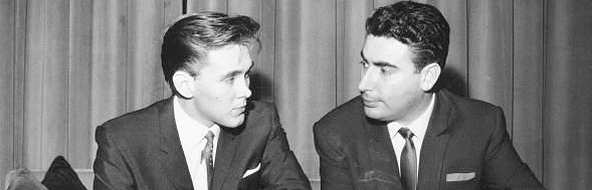
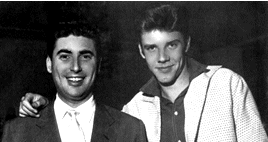
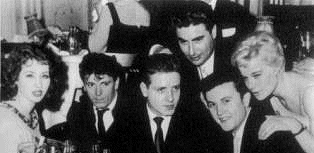
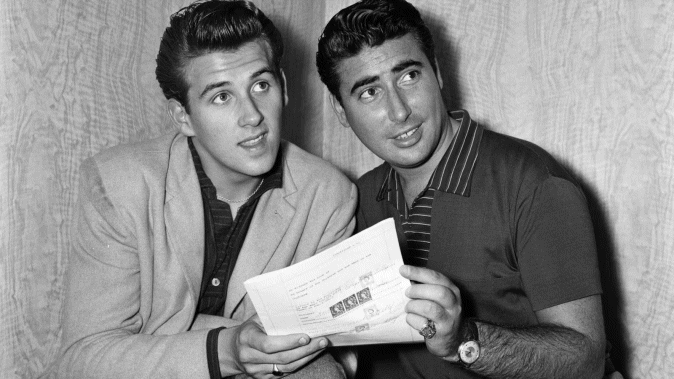
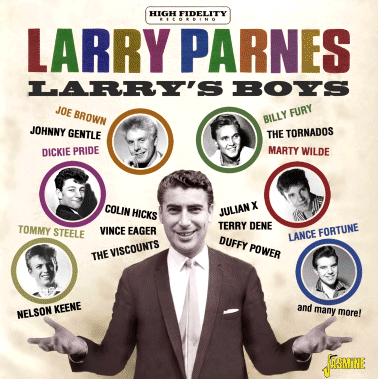
His second signing, Reg Smith had been spotted by songwriter Lionel Bart singing at the Condor Club and he told Parnes, who signed him up. Parnes chose the first name ‘Marty’ from the film and ‘Wild’ because it reflected part of Reg’s nature. Parnes gained the sobriquet of ‘Parnes, shilling and pence’ for his reported frugality with money – and he initially only paid his artists a weekly wage, causing some of them a degree of financial hardship. The artists were actually poorly paid, unlike pop artists of today, and Billy Fury, his biggest star, couldn’t even afford to pay for a car. Yet Parnes was to tell the press about his grooming of his discoveries, “I have their hair cut – that is very important. Sometimes they may have had skin which has to be attended to. Then I get them suitable clothes and provide them with comfort. I like them to have a touch of luxury from the start.” He launched his first variety show starring Marty Wilde in April 1958, and pioneered rock’n’roll package tours, promoted Sunday concerts and Summer Seasons at popular seaside resorts such as Great Yarmouth and Blackpool. He wrote the story for the Billy Fury film ‘I’ve Gotta Horse’ and produced it in 1965, a year after he’d produced his first film ‘Mods And Rockers’. Like a number of other managers in the Sixties – Brian Epstein, Simon Napier Bell – he was homosexual in a time when being ‘gay’ (a phrase not devised until the end of the decade) was unlawful in Britain. Naturally, he had a penchant for signing young boys and grooming them for stardom. The promoter had always been interested in the theatre and was involved in the musical ‘Half A Sixpence’ and a pantomime ‘Cinderella.’ By 1967 he felt he’d outgrown pop and his impact on the Beatles and other groups. He initially had problems trying to launch theatrical productions, so he bought the Cambridge Theatre on a 12-year lease and began to promote his own shows. Among the other ventures he was involved with were the musicals ‘Charley Girl’ and ‘Chicago.’ In 1983 he filed a suit against Paul McCartney and the BBC over comments made by Paul on his ‘Desert Island Discs’ appearance in January 1982. Paul had said that the group had never been paid for their Scottish tour. The legal dispute was eventually settled on the July 28th 1984 edition of the programme when Roy Plomley made a formal apology, although pointing out that Paul had only meant it as a joke. Parnes retired from business after contracting meningitis and he died on 4th August 1989. |
 |
 |
Bill
Harry attended
the Liverpool College of Art with Stuart Sutcliffe and John Lennon and made
the arrangements for Brian Epstein to visit The Cavern, where he saw The
Beatles for the first time. Bill was a member of 'The Dissenters' and the
founder and editor of 'Mersey Beat', the iconic weekly music newspaper
that documented the early Sixties music scene in the Liverpool area and
is possibly best known for being the first periodical to feature a local
band called 'The Beatles'. He has worked as a high powered publicist, doing PR for acts such as Suzi Quatro, Free, The Arrows and Hot Chocolate and has managed press campaigns for record labels such as CBS, EMI, Polydor. Bill is the critically acclaimed author of a large number of books about The Beatles and the 60s era including 'The Beatles Who's Who', 'The Best Years of the Beatles' and the Fab Four's 'Encyclopedia' series. He has appeared on 'Good Morning America' and has received a Gold Award from the British Academy of Songwriters, Composers and Authors. |
|
Article
Text
 Bill Harry Original
Graphics SixtiesCity
Other individual owner
copyrights may apply to Photographic Images Bill Harry Original
Graphics SixtiesCity
Other individual owner
copyrights may apply to Photographic ImagesUK
web hosting by
 |